
Robotics Jobs Skills Radar 2026: Emerging Tools, Frameworks & Technologies to Learn Now
The UK robotics sector is advancing rapidly—spanning autonomous vehicles, warehouse automation, surgical robots, and AI-powered drones. As funding and innovation grow, so does demand for robotics talent fluent in both software and physical systems.
Welcome to the Robotics Jobs Skills Radar 2026—your annual guide to the most in-demand programming languages, frameworks, simulation tools & embedded platforms shaping UK robotics careers. Whether you’re a robotics engineer, embedded developer or mechatronics graduate, this radar helps you focus on the skills that matter most.
Why Robotics Skills Are Growing in 2026
Modern robotics blends control theory, edge computing, computer vision and AI into real-time, physical systems. UK employers now expect robotics candidates to:
Build and test ROS-based modular software systems
Design and simulate robot arms, drones and mobile platforms
Use real-time sensor data to control movement and interaction
Integrate perception, motion planning, autonomy and safety
Communicate with cross-functional teams (hardware, software, ML, human factors)
Top Programming Languages for Robotics in 2026
1. C++
What it is: The standard language for low-latency robotics control, drivers and core ROS nodes.
Why it matters: Required for real-time performance, safety-critical logic and motion libraries.
Used by: Dyson, BAE Systems, Ocado Robotics, autonomous vehicle companies.
Roles: Robotics Software Engineer, Motion Control Developer, Embedded Roboticist.
Skills to pair: ROS 2 (rclcpp), TF2, MoveIt, Gazebo plugin dev.
2. Python
Where it fits: High-level control, perception, scripting, AI integration and prototyping.
Used by: Academic labs, SME robotics startups, simulation tools.
Roles: Perception Developer, Control Systems Engineer, R&D Engineer.
Skills to pair: rospy, OpenCV, NumPy, TensorFlow Lite, PyBullet.
3. Rust
Why it’s rising: Safer systems programming for embedded and real-time control.
Used by: Drone control frameworks, embedded robotics startups, aerospace safety.
Roles: Rust Firmware Engineer, Real-Time Systems Developer.
Skills to pair: async, WASM, ROS 2 Rust bindings (rclrs).
4. MATLAB / Simulink
Where it fits: Rapid prototyping, simulation and control system design.
Used by: Aerospace/automotive R&D, industrial robotics, academic research.
Skills to pair: Simscape Multibody, stateflow, system identification.
5. JavaScript (Node.js + React)
Where it fits: Robot web dashboards, remote interfaces, visualisation.
Used by: Fleet managers, drone operators, ROSBridge visualisation.
Essential Frameworks & Platforms to Master
1. ROS 2 (Robot Operating System)
What it is: A modular middleware for robotics software, now built for industry-grade applications.
Why it matters: Industry standard for robot software architecture.
Used by: Most UK robotics firms, research groups, startups.
Roles: ROS Developer, Motion Planner, Navigation Stack Engineer.
Skills to pair: nodes, topics, TF2, rclcpp, Nav2, lifecycle nodes.
2. Gazebo / Ignition
What it is: 3D robot simulator for testing sensor inputs, dynamics and control in virtual environments.
Why it matters: Sim-to-real is essential for rapid prototyping and regression testing.
Used by: Ocado, Dyson, university labs.
Skills to pair: URDF, SDF, plugin development, ROS integration.
3. MoveIt
What it is: Motion planning framework used with ROS for manipulators and arms.
Why it matters: Used in warehouse, surgical and mobile manipulation applications.
Skills to pair: inverse kinematics, collision avoidance, planning pipelines.
4. PX4 / ArduPilot
What it is: Open-source autopilot stacks for drones and aerial robotics.
Why it matters: Essential for building autonomous UAV platforms.
Used by: Defence robotics, environmental monitoring UAVs.
Skills to pair: MAVLink, QGroundControl, sensor fusion.
5. NVIDIA Isaac Sim
What it is: High-fidelity robotics simulator for AI training, synthetic data and vision pipelines.
Why it matters: Powers perception development, sim-to-real pipelines and photorealism.
Used by: Vision teams, autonomous vehicle startups.
Skills to pair: Jetson SDKs, DeepStream, Isaac ROS bridge.
AI, Perception & Autonomy Tools
▸ OpenCV
Core computer vision library used for image processing, object detection, feature tracking.
Roles: Vision Engineer, Robotics Perception Lead.
▸ YOLOv5 / Detectron2
Real-time object detection frameworks used in robot vision stacks.
Skills: bounding boxes, semantic segmentation, GPU acceleration.
▸ TensorRT / ONNX Runtime
Optimised inference engines for running AI models on edge hardware.
Used by: Jetson-powered platforms, embedded AI vision robots.
▸ Jetson SDKs (Nano, Xavier)
NVIDIA edge compute hardware and software stack used in mobile and embedded AI robotics.
Roles: Edge AI Developer, Perception Specialist.
▸ SLAM & Navigation
Tools: Cartographer, GMapping, Nav2, ORB-SLAM3.
Skills: LIDAR mapping, loop closure, localisation, path planning.
Embedded & Control Systems in Robotics
▸ Microcontrollers & Firmware
STM32, Teensy, Arduino, ESP32 for real-time actuator control and IO.
Roles: Embedded Robotics Engineer, Firmware Developer.
▸ RTOS (Real-Time Operating Systems)
FreeRTOS, Zephyr used for time-critical robotics applications.
Skills: task scheduling, low-latency interrupt handling, fault recovery.
▸ Hardware-in-the-loop (HIL) Testing
Integration of simulation with real sensors/controllers.
Tools: Simulink HIL, Gazebo HIL, custom embedded testbeds.
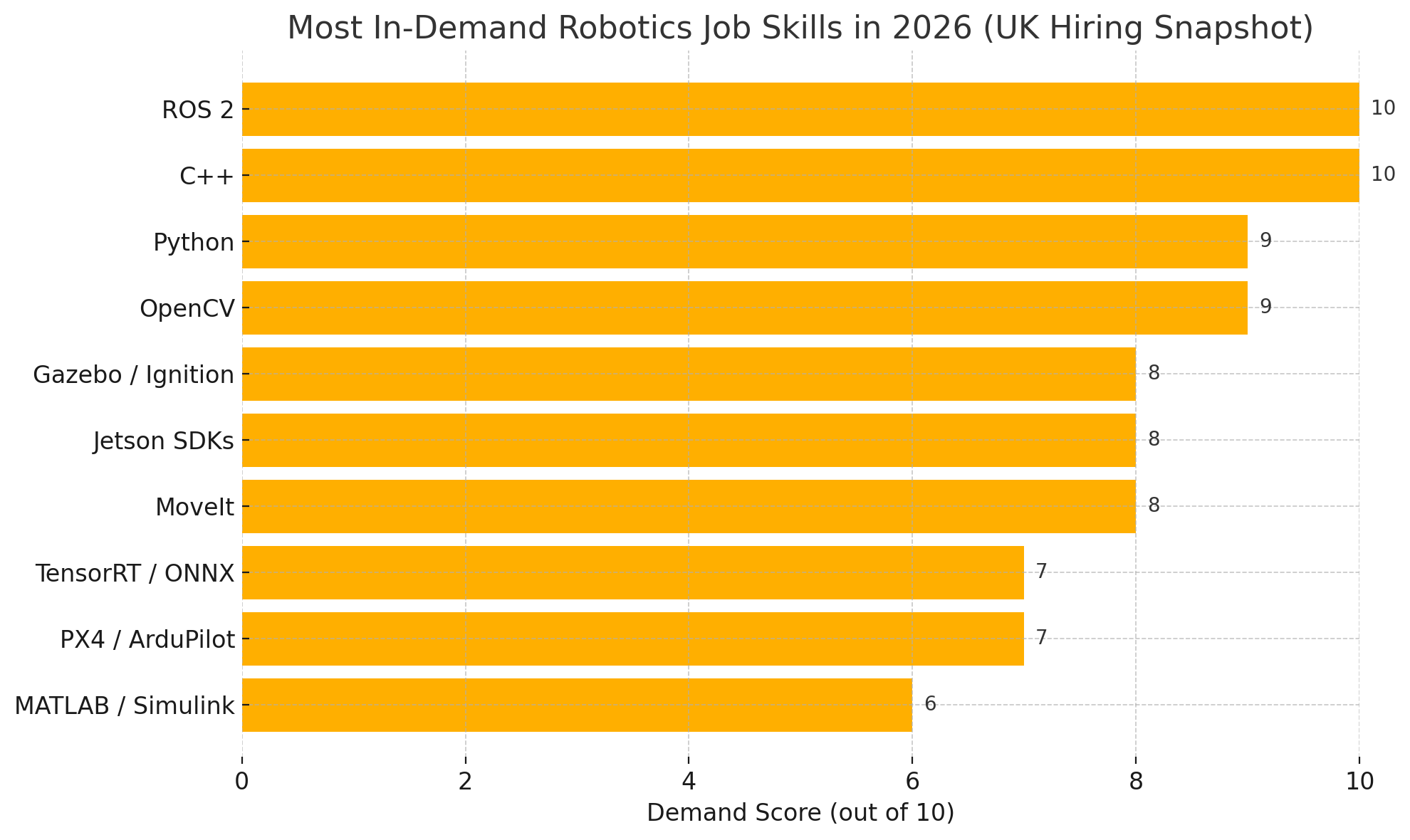
Most In-Demand Robotics Job Skills in 2026 (UK Hiring Snapshot Forecast)
Here’s a visual snapshot of the languages, frameworks & tools UK employers are prioritising for robotics roles:
How to Future-Proof Your Robotics Career in 2026
Master ROS 2 and C++ Together
These are foundational for most robotics companies building autonomous systems.Get Simulation & Real-World Experience
Use Gazebo, Isaac Sim or physical kits (TurtleBot, Jetson, drone dev boards).Combine AI with Edge Deployment
Learn to optimise & deploy AI models onto Jetson Nano, Coral, or PX4-compatible drones.Understand the Stack: From Sensors to Software
Gain fluency in embedded design, control theory, SLAM, motion planning & safety.Engage with the UK Robotics Ecosystem
Join the UK-RAS Network, attend Robotics and Automation Expo, and engage with Catapult centres and robotics startups.
Where to Find Robotics Jobs in the UK
🤖 Visit www.roboticsjobs.co.uk to explore UK-only listings across manufacturing automation, autonomous vehicles, defence robotics, surgical systems, drones & more.
Conclusion: Your Robotics Career Toolkit for 2026
As robotics moves deeper into real-world applications, engineers must combine systems thinking with real-time responsiveness and AI adaptability. From ROS 2 to perception stacks and firmware, the most in-demand professionals are those who can build robust systems from the ground up.
Use this Robotics Jobs Skills Radar 2026 to chart your training and job path—revisit it annually as the UK robotics landscape evolves.
Subscribe to our newsletter for weekly robotics jobs, skill spotlight features, salary trends & industry news.